

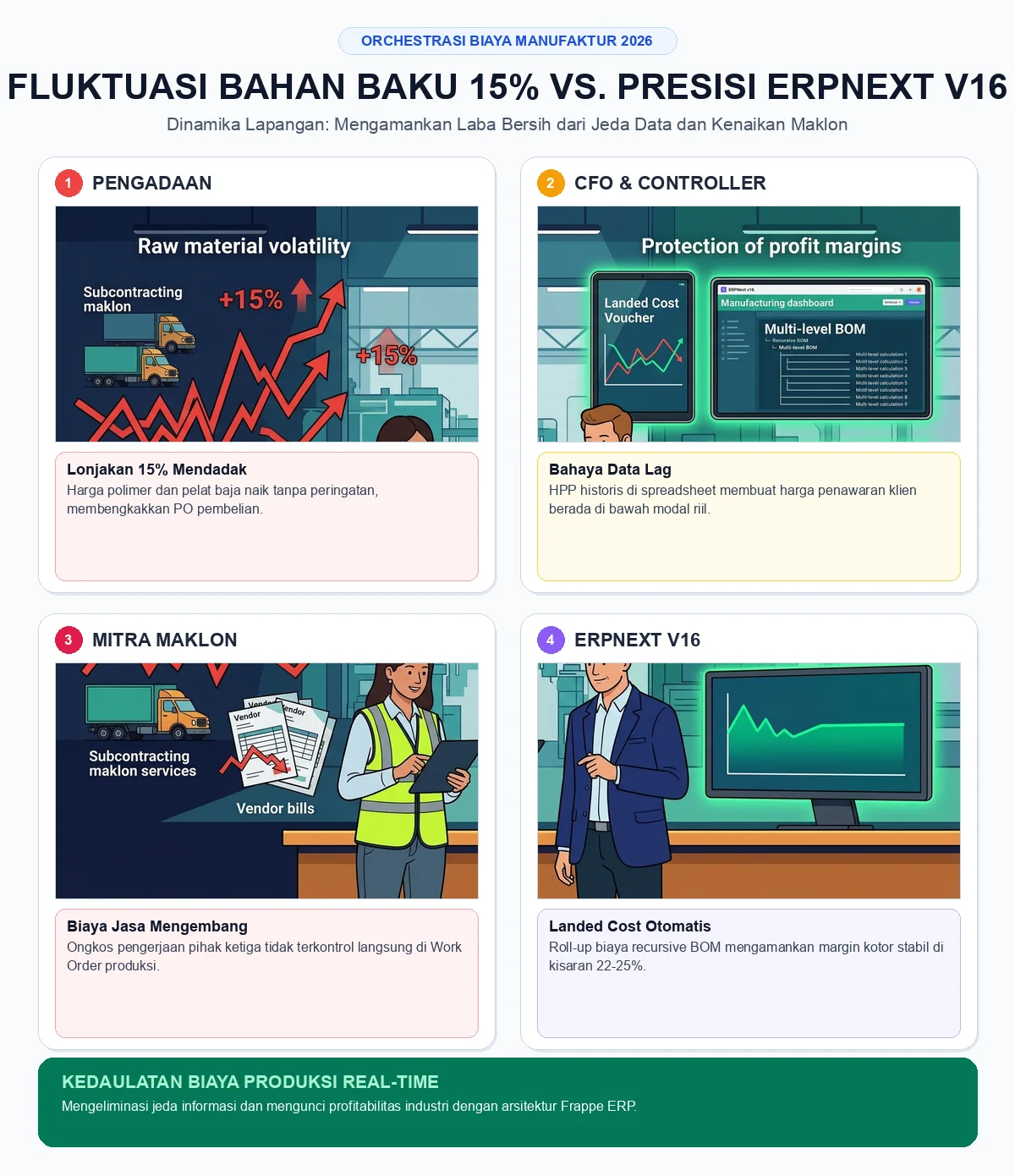
The manufacturing sector in 2026 faces a double challenge: global commodity price volatility and wage inflation driving up subcontracting costs. When key raw material prices spike by up to 15% within weeks, financial controllers often respond too late due to data lag. Without precise cost visibility, companies are trapped in underpricing or losing contracts to faster competitors.
ERPNext manufacturing cost prediction strategies are now the standard in factory financial governance. Serving as an operational control hub, ERPNext v16 dynamically integrates price lists, allocates actual landed costs, and simulates the impact of raw material surges directly onto unit Cost of Goods Manufactured (COGM).
Why Traditional Methods Fail Against 15% Volatility?
Many manufacturing facilities still rely on manual spreadsheets or disconnected legacy software across departments. The core issue is information latency (data lag). When polymer resin, copper, or steel sheet prices jump by 15% today, the impact only appears during month-end closing. By then, thousands of finished products have already shipped under outdated price quotes, eroding operating margins.
ERPNext v16 enforces a Single Source of Truth. Through the Landed Cost Voucher mechanism, shipping freight, customs duties, and handling expenses are proportionally capitalized into inventory valuation. This guarantees that your Cost of Goods Manufactured reflects present market conditions rather than three-month-old historical assumptions.
| Manufacturing Cost Parameter | Traditional Manual Method | ERPNext v16 Real-Time Automation | Net Margin Impact |
|---|---|---|---|
| Response to 15% Raw Material Surge | 14–30 day update lag (data lag) | Instantaneous recalculation on active Work Orders | Prevents profit leaks of $3,000–$8,000 per production batch |
| Landed Cost Attribution (Duties & Freight) | Estimated averages (distorted COGM) | Precision allocation via Landed Cost Vouchers | Stable gross profit margins maintained at 22–25% |
| Subcontracting Toll Service Volatility | Manual reconciliation at month-end | Service charges directly bound to vendor Job Cards | Eliminates unexpected vendor invoice variances |
| Sales Price Adjustment Agility | Slow (>7 business days, risk of loss) | Under 2 hours via Dynamic Price Lists | B2B quotations remain strictly above profitability thresholds |
- Response to 15% Raw Material Surge — Traditional Manual Method: 14–30 day update lag (data lag) | ERPNext v16 Real-Time Automation: Instantaneous recalculation on active Work Orders | Net Margin Impact: Prevents profit leaks of $3,000–$8,000 per production batch
- Landed Cost Attribution (Duties & Freight) — Traditional Manual Method: Estimated averages (distorted COGM) | ERPNext v16 Real-Time Automation: Precision allocation via Landed Cost Vouchers | Net Margin Impact: Stable gross profit margins maintained at 22–25%
- Subcontracting Toll Service Volatility — Traditional Manual Method: Manual reconciliation at month-end | ERPNext v16 Real-Time Automation: Service charges directly bound to vendor Job Cards | Net Margin Impact: Eliminates unexpected vendor invoice variances
- Sales Price Adjustment Agility — Traditional Manual Method: Slow (>7 business days, risk of loss) | ERPNext v16 Real-Time Automation: Under 2 hours via Dynamic Price Lists | Net Margin Impact: B2B quotations remain strictly above profitability thresholds
Securing Margins with Multi-Level BOM Precision
Predictive costing cannot function in a silo without robust product engineering foundations. In complex discrete manufacturing, a finished product consists of dozens of sub-assemblies and hundreds of components. This framework relies directly on implementing multi-level BOM architecture, where each assembly level possesses its own discrete cost structure.
When a 15% raw material spike occurs in a tier-3 fastener or chemical additive, ERPNext v16 automatically executes a recursive cost roll-up through intermediate assemblies up to the finished product. Operations managers immediately know that a 15% raw material surge translates into a precise 1.8% finished good cost increase, enabling data-driven commercial adjustments without blind speculation.
Subcontracting Efficiency & External Service Governance
Beyond raw materials, outsourced toll manufacturing and subcontracted finishing are frequent culprits of budget overruns. Rising labor rates and vendor energy surcharges can undermine financial forecasts unless monitored centrally.
This is where synergy with subcontracting manufacturing efficiency becomes vital. Through unified Subcontracting Purchase Orders and Subcontract Receipts in ERPNext v16, raw materials dispatched to third-party processors remain tracked as stock at supplier. Once processed goods return to the plant, supplier service fees are automatically added to the item’s valuation, eliminating reconciliation surprises.
To support compute-heavy workloads processing thousands of real-time material movements, dedicated cloud hosting is essential. Deploying on high-performance cloud environments like Hostinger KVM VPS with additional discount using promo code 6X5PUTERARQL provides the database stability and Redis caching performance needed by enterprise ERPNext v16 instances with predictable hosting overhead.
Tactical Action Steps for Cost Fluctuation Mitigation
- Tiered Buying Price Lists: Configure dynamic supplier price lists to automatically compare competing quotes for critical raw materials.
- Cost Variance Auditing: Run routine comparisons between Standard Costing and Moving Average actual costs to identify budget deviations before production runs finish.
- Frappe Server Scripts: Deploy automated triggers that alert procurement teams whenever raw material purchase prices exceed a 5% volatility threshold.
Building Modern Manufacturing Resilience
Protecting operational margins against 2026 market volatility requires data velocity and calculation precision. ERPNext v16 is not just a ledger, but a proactive financial risk mitigation engine that preserves full enterprise data sovereignty in private cloud environments. For manufacturing organizations looking to deploy without architectural misconfigurations, the implementation specialists at Samkarsa.com provide tailored Frappe Framework customization and business process engineering.
Transparency: Some links in this article are affiliate links that may earn us a commission at no additional cost to you.
Social Media Share
Copy text or open your social media directly
Running a 2026 manufacturing plant on manual spreadsheets is a recipe for disaster. When raw material costs spike by 15% today, data lag in manual reporting won't show the impact until next month. By then, your net margins are already gone.
Data lag kills profit. ERPNext v16 eliminates this gap via Landed Cost Vouchers. Every increase in shipping, duties, and handling fees is directly attributed to stock value in real-time, replacing obsolete historical costs.
Tactical move: Implement a Single Source of Truth. With integrated data architecture, you can run cost simulations before signing contracts. This ensures sales pricing remains competitive without sacrificing the bottom line.
Secure your manufacturing margins against raw material volatility and subcontracting wage inflation. Read the full strategy: https://bijaktechnology.com/en/blog/prediksi-biaya-manufaktur-erpnext-fluktuasi-harga/ #ERPNext #Manufacturing
💡 How to publish cleanly on Medium.com: