

The implementation of Retrieval-Augmented Generation (RAG) architectures now demands stricter infrastructure efficiency. Many engineering teams initially opted for fully-managed vector databases like Pinecone or AWS OpenSearch. However, as data grows to millions of vectors, operational expenses (OpEx) often spike without significant performance gains.
As an alternative, the pgvector extension on PostgreSQL, run in a self-hosted environment, has become the new standard. By using the open-source PaaS platform Coolify on private servers, teams can maintain full data sovereignty without the burden of expensive per-query billing.
Self-Hosted vs Managed Cloud: Control & Latency
A major drawback of managed vector database solutions is the physical separation of primary relational data from vector embedding storage. Every similarity search requires cross-network API calls, adding network overhead and latency.
The pgvector architecture allows for storing both transactional attributes and vector embeddings within a single PostgreSQL instance. This integration simplifies SQL queries by combining standard clauses with K-Nearest Neighbors (KNN) searches. To keep HNSW (Hierarchical Navigable Small World) index latency below 10ms, memory configurations must be precisely tuned. Technical details on RAM allocation can be found in our guide on production pgvector optimization.
| Metric | Self-Hosted pgvector (Coolify + VPS) | Managed Cloud Vector DB |
|---|---|---|
| Cost Model | Predictable flat monthly rate | Pay-per-query & expensive RAM |
| Data Location | Isolated in private VPS | Multi-tenant cloud |
| Network Latency | Ultra-low (Co-located) | External API hop overhead |
| DevOps | Automated via Coolify UI | Managed by provider |
- Cost Model — Self-Hosted pgvector (Coolify + VPS): Predictable flat monthly rate | Managed Cloud Vector DB: Pay-per-query & expensive RAM
- Data Location — Self-Hosted pgvector (Coolify + VPS): Isolated in private VPS | Managed Cloud Vector DB: Multi-tenant cloud
- Network Latency — Self-Hosted pgvector (Coolify + VPS): Ultra-low (Co-located) | Managed Cloud Vector DB: External API hop overhead
- DevOps — Self-Hosted pgvector (Coolify + VPS): Automated via Coolify UI | Managed Cloud Vector DB: Managed by provider
Efficiency Analysis: Save 70% with Coolify & Hostinger VPS
The main barrier to self-hosting is usually DevOps complexity. Coolify eliminates this by automating deployments, SSL certificates, and Docker container management through an intuitive web interface.
From a budget perspective, running pgvector on KVM VPS infrastructure provides a superior price-to-performance ratio. Mid-tier managed cloud instances can cost thousands of dollars per month. In contrast, by using a Hostinger KVM VPS plan (use coupon code [6X5PUTERARQL](/go/hostinger/)), you get dedicated RAM and high-performance NVMe CPUs at a fraction of the cost.
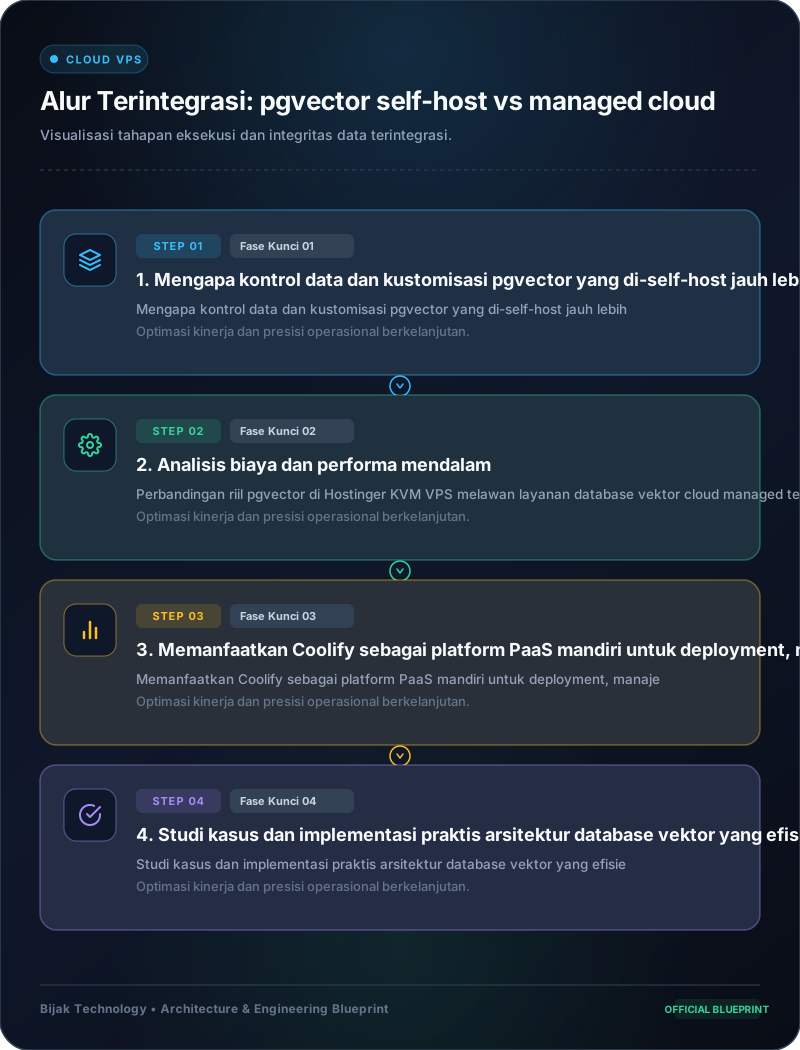
AI Agent Implementation & Data Sovereignty
In automation ecosystems, pgvector acts as the long-term memory for AI Agents. When integrated with workflow engines, this database stores conversation context and internal documents in real-time.
For organizations building AI agent automation deployments, self-hosted infrastructure ensures sensitive data does not leak to third parties. If business scale requires high-level privacy compliance, consulting with private cloud specialists like Samkarsa can facilitate a secure infrastructure transition.
Production Technical Checklist:
- Allocate 25%-50% of system RAM to
shared_buffers. - Ensure
work_memis large enough to fit HNSW indexes in memory. - Use internal connections (localhost/Docker network) to minimize query latency.
Strategic Conclusion
Self-hosting pgvector via Coolify on Hostinger VPS is a logical architectural decision for cost sustainability. This strategy offers up to 70% savings, minimal latency, and full control over corporate data assets in 2026.
Social Media Share
Copy text or open your social media directly
Fully-managed vector databases like Pinecone or OpenSearch become financially unsustainable once your RAG architecture scales to millions of embeddings.
Decoupling relational data from vector embeddings introduces unnecessary network overhead and latency on every single API call, inflating OpEx via pay-per-query pricing.
Co-locating transactional data and vector embeddings in PostgreSQL via pgvector eliminates network hops. Proper HNSW index tuning keeps KNN search latency under 10ms.
Self-hosting pgvector with Coolify PaaS on a Hostinger VPS grants full data sovereignty while cutting AI infra costs by 70%. Deep dive analysis: https://bijaktechnology.com/en/blog/pgvector-self-host-efisiensi-coolify-hostinger-vps-vs-managed-cloud #PostgreSQL #AIInfrastructure
💡 How to publish cleanly on Medium.com: