Real World Asset (RWA) Tokenization: How It Works, Legal-Technical Architecture, and Capital Liquidity on Blockchain
A comprehensive enterprise guide to Real World Asset (RWA) tokenization. Learn how commercial real estate, debt instruments, and commodities are legally converted into liquid, compliant on-chain digital tokens.


[!NOTE] Regulatory Notice & Financial Disclaimer (YMYL): This technical publication is prepared strictly for educational analysis of distributed ledger systems architecture and software engineering design. All third-party market projections (including Boston Consulting Group and Citibank estimates) are referenced from public industry reports for technical benchmarking and do not constitute investment advice, financial solicitation, or securities recommendations.
For decades, prime investment instruments—such as commercial office towers, sovereign treasury bonds, productive agricultural acreage, and high-value logistics real estate—have been exclusively monopolized by multi-billion-dollar institutions. Accredited and retail investors alike faced steep barriers to entry, multi-week manual due diligence procedures, and rigid illiquidity in secondary OTC markets.
The emergence of Real World Asset (RWA) Tokenization fundamentally dismantles this legacy bottleneck. By leveraging distributed ledger technology, tangible real-world collateral is represented as fractional digital tokens on-chain without forfeiting statutory private property legal protections.
Far from being a transient tech narrative, research publications from global management consultancies like Boston Consulting Group and Citibank project the tokenized asset market to surpass $16 trillion by 2030, establishing it as the single most critical structural convergence between Traditional Finance (TradFi) and decentralized capital markets.
1. What is Real World Asset (RWA) Tokenization?
At its core, Real World Asset (RWA) Tokenization is the process of converting ownership titles, equitable shares, or contractual cash-flow rights from tangible physical assets and conventional financial instruments into programmable digital tokens hosted on a blockchain network.
Every token minted carries intrinsic economic value directly tethered to verifiable underlying collateral. Unlike purely speculative cryptocurrencies whose market pricing depends exclusively on secondary sentiment cycles, RWA tokens derive pricing integrity from audited net asset value (NAV), rental yields, or statutory coupon payments.
Asset Classes Primed for Tokenization:
- Commercial Real Estate: Logistics parks, multi-tenant corporate offices, industrial warehouses, and development land.
- Fixed Income Instruments: Sovereign government debt (Treasury Bills), corporate credit notes, and municipal bonds.
- Private Equity & Venture Capital: Unlisted pre-IPO corporate equity, venture fund carry, and mezzanine facilities.
- Commodities & Precious Metals: Certified physical bullion bars, energy reserves, and audited agricultural stockpiles.
- Trade Finance & Credit Receivables: Commercial accounts receivable, factoring notes, and regional supply chain liquidity lines.
To understand why decentralized consensus guarantees higher operational integrity and immutability than legacy centralized database architectures, read our technical primer on the fundamental differences between databases and blockchain networks.
2. Comparative Matrix: Traditional Finance vs. Pure Cryptocurrencies vs. RWA
To understand RWA’s strategic positioning within modern enterprise balance sheets, consider the following structural comparison:
| Parameter | Conventional Finance (TradFi) | Native Cryptocurrencies | RWA Tokenization |
|---|---|---|---|
| Underlying Value Anchor | Physical assets & paper contracts | Consensus algorithms & market sentiment | Tangible Collateral + Smart Contracts |
| Minimum Capital Barrier | Ultra-high (tens of thousands to millions) | Micro-fractional (cents) | Low to Medium (fractional entry) |
| Settlement Finality | 2 to 5 business days (T+2 / T+3) | Minutes / Network Finality | Instant Real-Time 24/7 Finality |
| Ownership Registry | Siloed in custodial registries & notary books | Public & pseudonymously verified | Audited on-chain records backed by SPV |
| Regulatory Architecture | Manual bureaucratic compliance | Variable / Disintermediated | Embedded programmatic compliance (ERC-3643 / ERC-7943) |
- Underlying Value Anchor — Conventional Finance (TradFi): Physical assets & paper contracts | Native Cryptocurrencies: Consensus algorithms & market sentiment | RWA Tokenization: Tangible Collateral + Smart Contracts
- Minimum Capital Barrier — Conventional Finance (TradFi): Ultra-high (tens of thousands to millions) | Native Cryptocurrencies: Micro-fractional (cents) | RWA Tokenization: Low to Medium (fractional entry)
- Settlement Finality — Conventional Finance (TradFi): 2 to 5 business days (T+2 / T+3) | Native Cryptocurrencies: Minutes / Network Finality | RWA Tokenization: Instant Real-Time 24/7 Finality
- Ownership Registry — Conventional Finance (TradFi): Siloed in custodial registries & notary books | Native Cryptocurrencies: Public & pseudonymously verified | RWA Tokenization: Audited on-chain records backed by SPV
- Regulatory Architecture — Conventional Finance (TradFi): Manual bureaucratic compliance | Native Cryptocurrencies: Variable / Disintermediated | RWA Tokenization: Embedded programmatic compliance (ERC-3643 / ERC-7943)
3. Technical Architecture and the 5-Stage Tokenization Lifecycle
Transforming an off-chain physical asset into an on-chain token demands synchronization across statutory legal structures, certified independent physical appraisal, and exploit-resistant smart contract architecture.
Below is the complete architectural lifecycle:
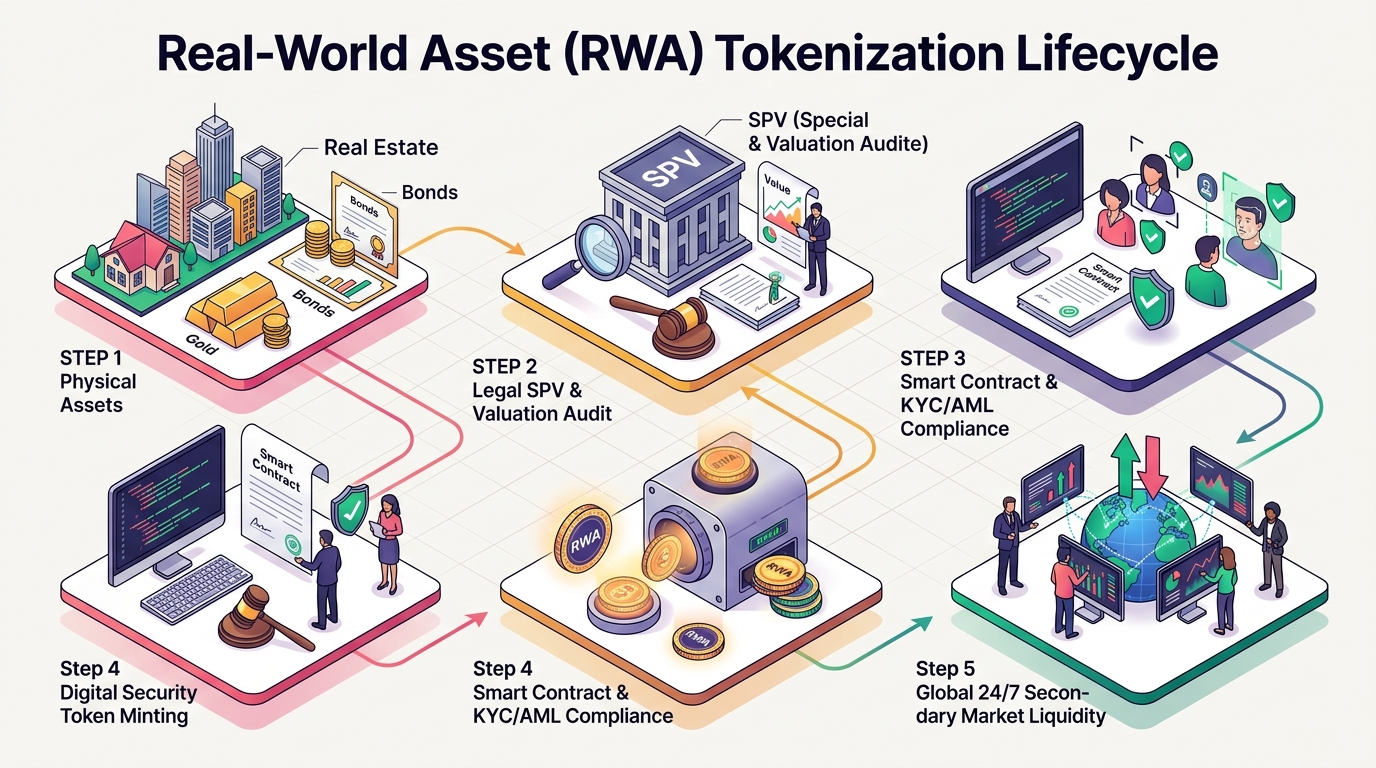
5 Critical Phases of the Tokenization Workflow:
- Asset Identification & Valuation (Off-Chain): Certified independent appraisal to determine Net Asset Value (NAV) and title deed authenticity verification.
- Special Purpose Vehicle (SPV) Scaffolding: Incorporation of an isolated bankruptcy-remote SPV (e.g., in Delaware, Singapore, or Switzerland) to legally hold unencumbered asset titles.
- Embedded Compliance & Smart Contract Design: Deploying permissioned protocols such as ERC-3643 (T-REX) or ERC-7943 coupled with on-chain KYC/AML identity registries.
- Token Minting & Distribution (On-Chain): Minting fractional security tokens that represent verified legal equity shares in the underlying SPV entity.
- Secondary Market Settlement (24/7): Distributing tokens across regulated alternative trading systems (ATS) or decentralized liquidity venues with automated settlement.
Leading enterprise ecosystems provide purpose-built sovereign infrastructure for this paradigm. For instance, institutional initiatives like the Avalanche Vista asset tokenization program deploy multi-million dollar structured debt instruments under full regulatory oversight.
4. Anatomy of Embedded On-Chain Compliance
The defining attribute separating institutional RWA tokens from standard permissionless cryptocurrencies is programmatic compliance enforced directly within the contract state via standards like ERC-3643 and ERC-7943.
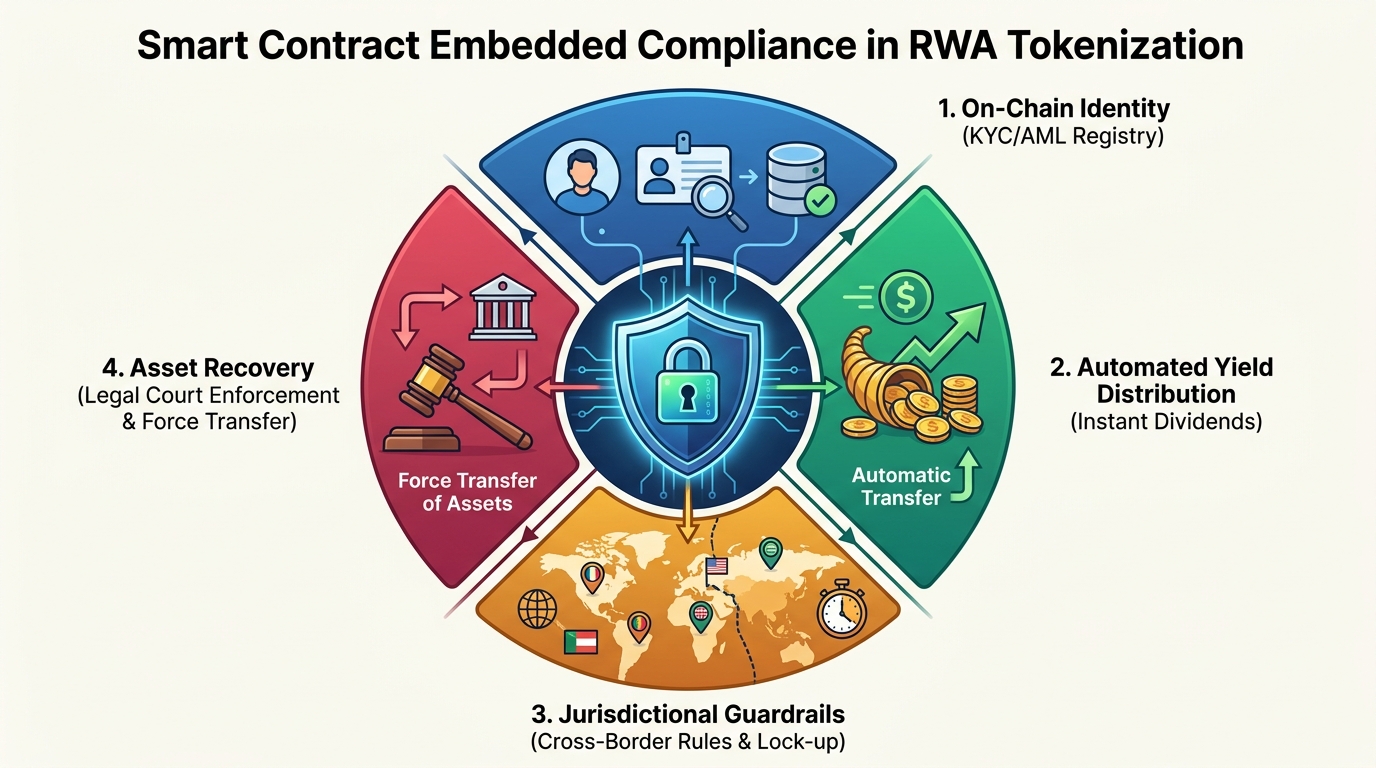
The 4 Pillars of Smart Contract Compliance:
- 1. On-Chain Identity Verification (KYC/AML Registry): Every transaction queries an on-chain identity claim (such as ONCHAINID). Tokens cannot be transferred to addresses failing accreditation criteria.
- 2. Automated Yield & Dividend Distribution: Rental payments or coupon flows are autonomously distributed pro-rata to active token holders in real-time without custodial deductions.
- 3. Jurisdictional & Shareholder Caps: Smart contracts automatically enforce maximum accredited shareholder thresholds per country and statutory lock-up holding periods (e.g., US SEC Rule 144).
- 4. Court-Mandated Asset Recovery & Forced Transfers: In legal dispute resolutions or lost credential events, authorized issuers retain cryptographically audited powers to burn lost tokens and re-issue them to legitimate claimants.
5. Secondary Market Liquidity and Interoperability
Once an asset is tokenized and compliant, global 24/7 liquidity unlocked through interoperable protocols changes the game:
- On-Chain Order Books & Institutional Liquidity: Market participants trade without opaque broker-dealer spreads. On-chain Central Limit Order Books provide real-time bid-ask transparency.
- Cross-Chain Asset Mobility: Assets minted on a sovereign Avalanche L1 can be seamlessly transferred, borrowed against, or bridged across compliant environments using Avalanche Interchain Messaging (ICM) and Teleporter.
6. Practical Industry Challenges
While the financial potential is immense, enterprise deployment requires active risk engineering:
- Cross-Border Legal Harmonization: Property rights and securities acts vary between jurisdictions, requiring multi-jurisdictional legal structuring.
- Oracle Latency & Proof of Reserve: Physical asset valuations require continuous real-time verification via decentralized oracle networks like Chainlink Proof of Reserve.
- Institutional-Grade Custody: Tier-1 asset managers demand multi-party computation (MPC) key custody and comprehensive insurance underwriting.
Conclusion: The Strategic Horizon of Enterprise Asset Digitalization
Real World Asset tokenization connects the liquidity velocity of programmable blockchains with the enduring capital value of real-world tangible assets. By eliminating intermediary drag, expanding investor access through fractionalization, and embedding legal compliance into smart contract code, RWA is establishing itself as the premier paradigm for institutional asset management.
For enterprises planning to deploy compliant tokenization infrastructure or launch sovereign Avalanche L1 networks, understanding this architecture is essential to staying ahead of global capital market shifts.
Primary References & Technical Publications
- Boston Consulting Group (BCG) - Relevance of On-Chain Asset Tokenization
- Citibank Global Perspectives & Solutions (Citi GPS) - Money, Tokens, and Games: Blockchain’s Next Billion Users
- Ethereum Improvement Proposals - ERC-3643 Permissioned Token Standard
Disclaimer: Bijak Technology does not provide investment management, securities advisory, or cryptocurrency custody services. This review is intended for software systems architects and computer science professionals.
About the Author: Iswan Putera is Principal Software Architect and Lead Technology Writer at Bijak Technology with over a decade of hands-on experience in distributed systems, Linux cloud infrastructure, and enterprise ERPNext implementations. Connect directly via LinkedIn, commercial portfolio Samkarsa, or email redaksi@bijaktechnology.com.
Explore More: Blockchain



Iswan Putera
Principal Software ArchitectSoftware Architect & Senior Systems Engineer with over a decade of hands-on expertise in distributed architectures, Linux private cloud deployments, and enterprise ERP implementations. Serves as Lead Technology Writer at Bijak Technology.
Social Media Share
Copy text or open your social media directly
💡 How to publish cleanly on Medium.com: